Tile Calculator: Why the Same Square Footage Can Give Different Tile Counts
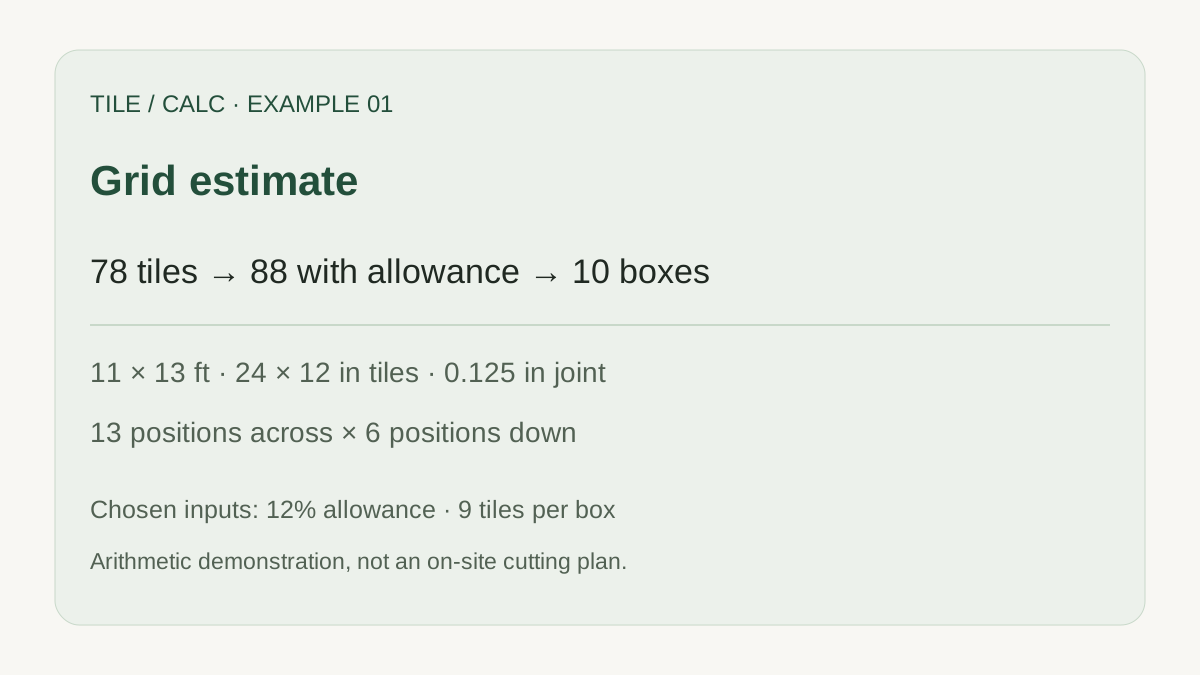
For our example, an 11 × 13 ft rectangle needs 78 tile positions in grid mode, but entering only its 143 ft² area gives 71 tiles. With our chosen 12% allowance and nine tiles per box, those estimates become ten boxes and nine boxes. Neither number is an on-site cutting plan. Grid mode counts every edge position as a whole tile; area mode cannot see those edges.
Use the tile calculator to enter your own measurements. The example below uses 24 × 12 in tiles, a 0.125 in joint, nine tiles per box and a 12% allowance. We selected these inputs to show the difference between two methods. They are not a universal waste recommendation, a product specification or measurements from a customer's home.
Our reproducible comparison
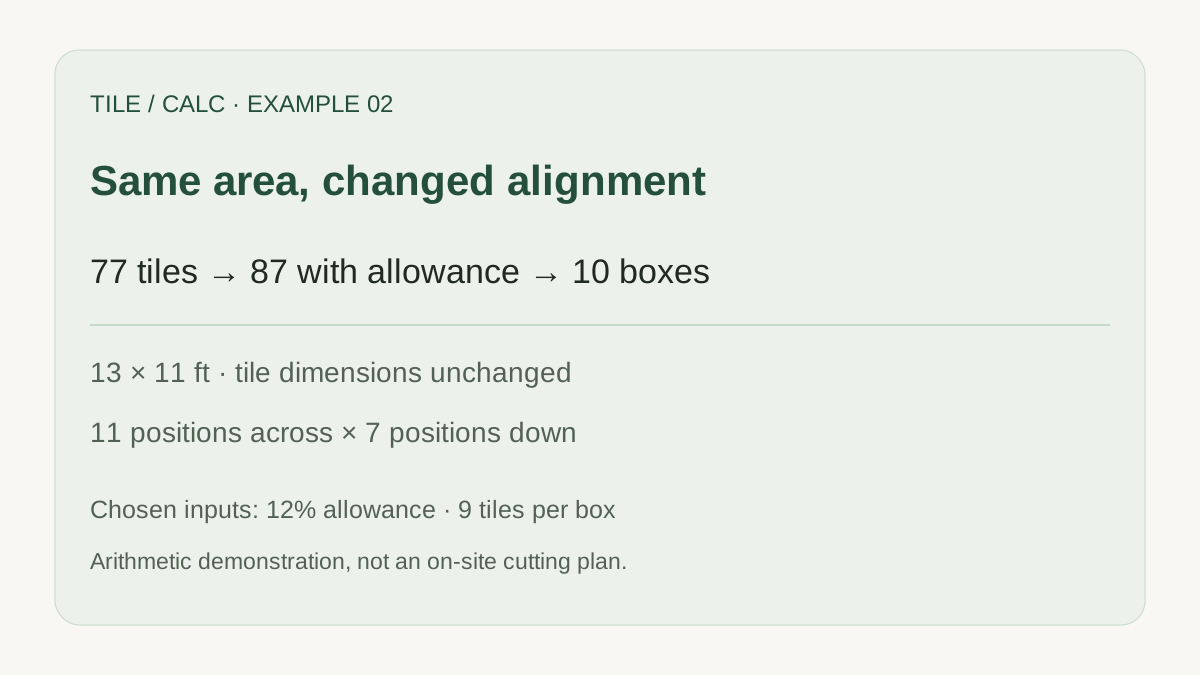
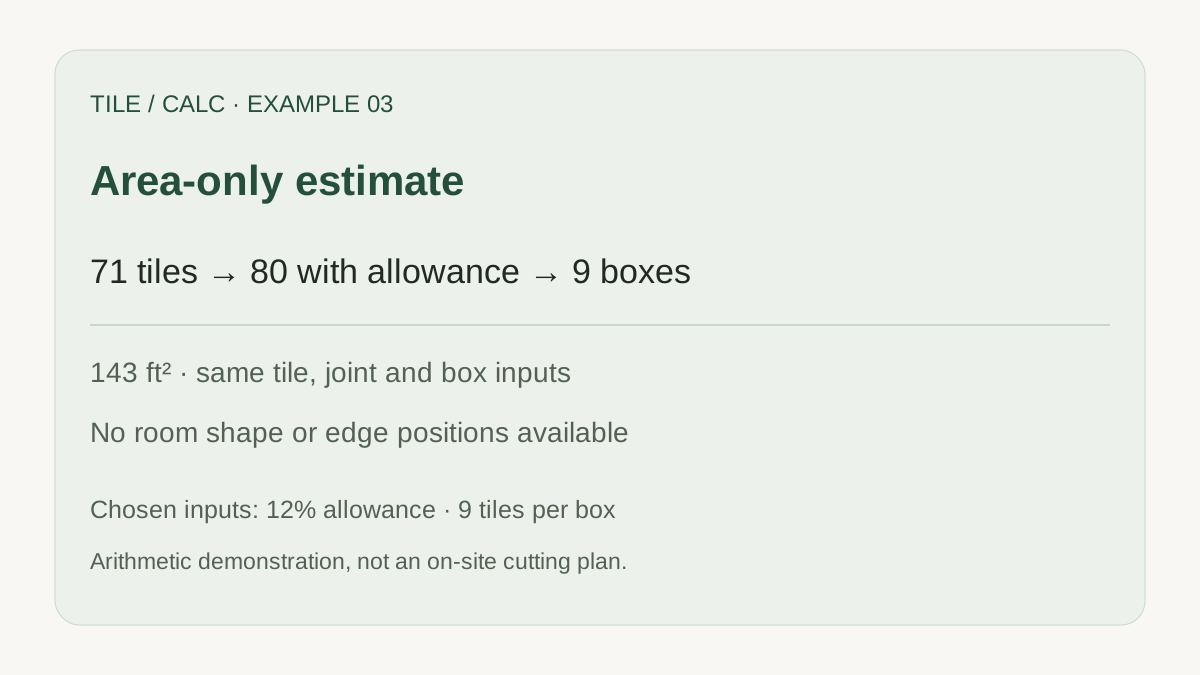
We ran the site's existing calculation function three times, keeping tile dimensions, joint width, box capacity and allowance fixed. In the first run the room length was 11 ft and its width was 13 ft. In the second, those room dimensions were exchanged while the tile length and width stayed fixed. That changes how the rectangular tiles are oriented relative to the room. The third run supplied only the total area, 143 ft².
| Input method | Tiles before allowance | Tiles including 12% | Boxes of nine | Tiles delivered |
|---|---|---|---|---|
| Grid: length 11 ft, width 13 ft | 78 | 88 | 10 | 90 |
| Grid: length 13 ft, width 11 ft | 77 | 87 | 10 | 90 |
| Area only: 143 ft² | 71 | 80 | 9 | 81 |
For the first grid, convert the room dimensions to inches: 11 × 12 = 132 and 13 × 12 = 156. Across the width, round up (156 + 0.125) ÷ (12 + 0.125) to 13 positions. Down the length, round up (132 + 0.125) ÷ (24 + 0.125) to six positions. Multiply 13 × 6 to obtain 78. The calculation counts the edge positions as whole tiles even when part of each position would be cut away.
Now apply the allowance and packaging separately. Round up 78 × 1.12 to 88 tiles. Divide 88 by nine and round up to ten boxes. Ten boxes contain 90 tiles, leaving two tiles above the allowance-adjusted number. Those two tiles come from packaging, not from changing the selected 12% allowance.
Exchange the room dimensions without exchanging the tile dimensions. The width calculation becomes round up (132 + 0.125) ÷ (12 + 0.125), or 11 positions. The length calculation becomes round up (156 + 0.125) ÷ (24 + 0.125), or seven positions. That gives 77 tile positions. Applying 12% gives 87 tiles, which still rounds to ten boxes. A one-tile change in the grid therefore does not necessarily change the purchase quantity.
For area-only mode, first express the tile-and-joint footprint in square feet: (24.125 ÷ 12) × (12.125 ÷ 12). Divide 143 by that footprint and round up to 71. Apply the same allowance to get 80 tiles, then round up 80 ÷ 9 to nine boxes containing 81 tiles. This estimate has no information about the room's width, length or orientation.
The seven-position difference between the first grid and the area estimate is a consequence of these specific formulas and inputs. It does not establish a general percentage to add to every area estimate. Nor does the nine-tile difference between the two delivered quantities prove that those nine extra tiles are needed on site. A cutting plan that reuses offcuts may produce another result.
Which result should you use?
Use dimensions when you know the rectangular surfaces and want the site's straight-grid count. Use area-only mode when square footage is all you have, while keeping its missing shape information in mind. Confirm a final order against the layout and the packaging you will actually buy.
Our grid calculation does not optimize offcut reuse, tile starting offsets, diagonal patterns, staggered patterns or obstacles. Its allowance is a separate input. You should not quietly treat that input as an automatic correction for every difference between methods.
Questions answered
Does changing the tile direction change the square footage?
No. Both rectangles in our comparison have an area of 143 ft². The grid count changes because the tile length and width align with different room dimensions. If you exchange both the room dimensions and the tile dimensions, you preserve the same alignment instead of testing a new direction.
Why can two tile counts require the same number of boxes?
Boxes are rounded up independently. In this example, both 88 and 87 requested tiles fit within ten boxes of nine. Check the box capacity before treating a difference in calculated tiles as a difference in purchasing cost.
Is the 12% allowance recommended for every project?
No. It is an input we chose for this comparison. Replace it with the allowance for your own plan. This article does not claim an industry-wide allowance or predict breakage.
Can area-only mode replace a cutting layout?
No. It uses a tile-and-joint footprint and a total area. It cannot locate partial edge tiles or decide whether a cut piece can be reused elsewhere.
Method record
This comparison was calculated on October 3, 2026 using the current site calculator and the publicly described grid and area formulas. The inputs were authored for this demonstration. These are arithmetic results, not traffic measurements, supplier quotes or a field installation test.