Our single-cut remainder experiment
We chose a rectangular strip with an actual length of 24 inches and a constant width. We require a first piece exactly 12 inches long and ask whether the remaining piece can also be 12 inches long. For this arithmetic experiment only, the single transverse cut consumes 0.125 inch along the length. These numbers are authored inputs, not a customer's measurements, a nominal product size, a measured saw test or a blade recommendation.
Start with a length ledger: first piece + consumed cut width + remainder = original stock. Put our numbers into it: 12 + 0.125 + 11.875 = 24 inches. The second piece is therefore 11.875 inches, which is 0.125 inch short of the requested twelve. The first piece is already finished to its specified length; the consumed strip lies after it. Counting the cut width inside the first piece would describe a different first-piece length.
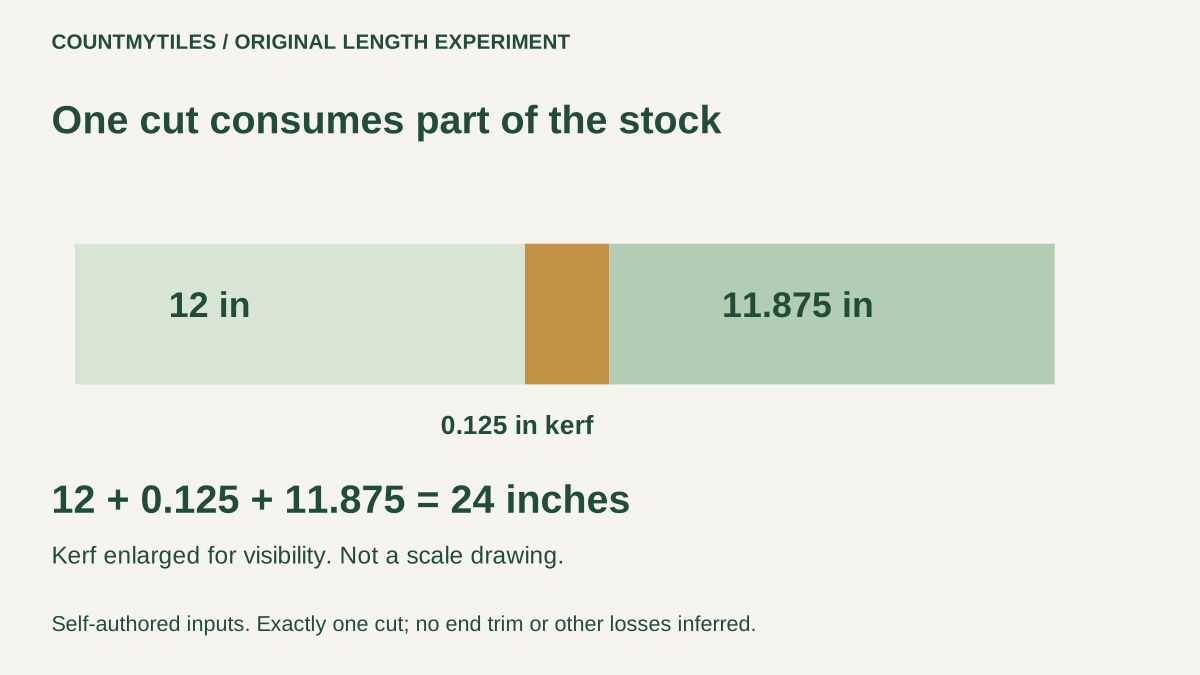
Now hold the two required lengths at twelve and solve for the minimum stock length. Add 12 + 0.125 + 12 to obtain 24.125 inches. In the model, this longer stock produces a twelve-inch first piece and a twelve-inch remainder with exactly one cut. The extra 0.125 inch is a specific consumed length. It is not a percentage allowance, an extra grout joint or a whole additional tile.
Our first control sets the consumed width to zero while keeping 24 inches of stock and a twelve-inch first piece. The remainder becomes twelve. This is idealized zero-loss arithmetic, useful for isolating the effect of the kerf input. It does not establish that an actual saw or another cutting process loses no material. Change only the kerf back to 0.125, and the missing eighth of an inch returns.
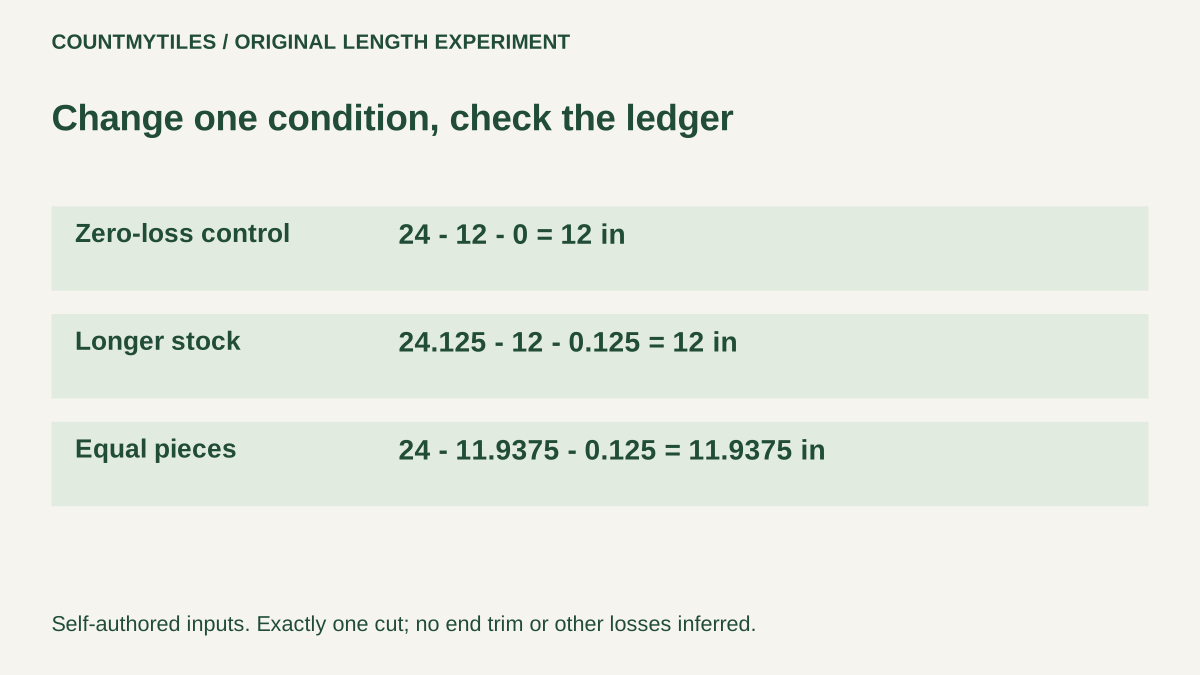
A second control asks for equal pieces from the original 24-inch stock. The one cut consumes 0.125 inch, leaving 23.875 inches for the two pieces together. Divide that by two to obtain 11.9375 inches per piece. Verify it by addition: 11.9375 + 0.125 + 11.9375 = 24. The pieces are equal, but neither is twelve. Equal halves of the remaining material are different from half the uncut stock length.
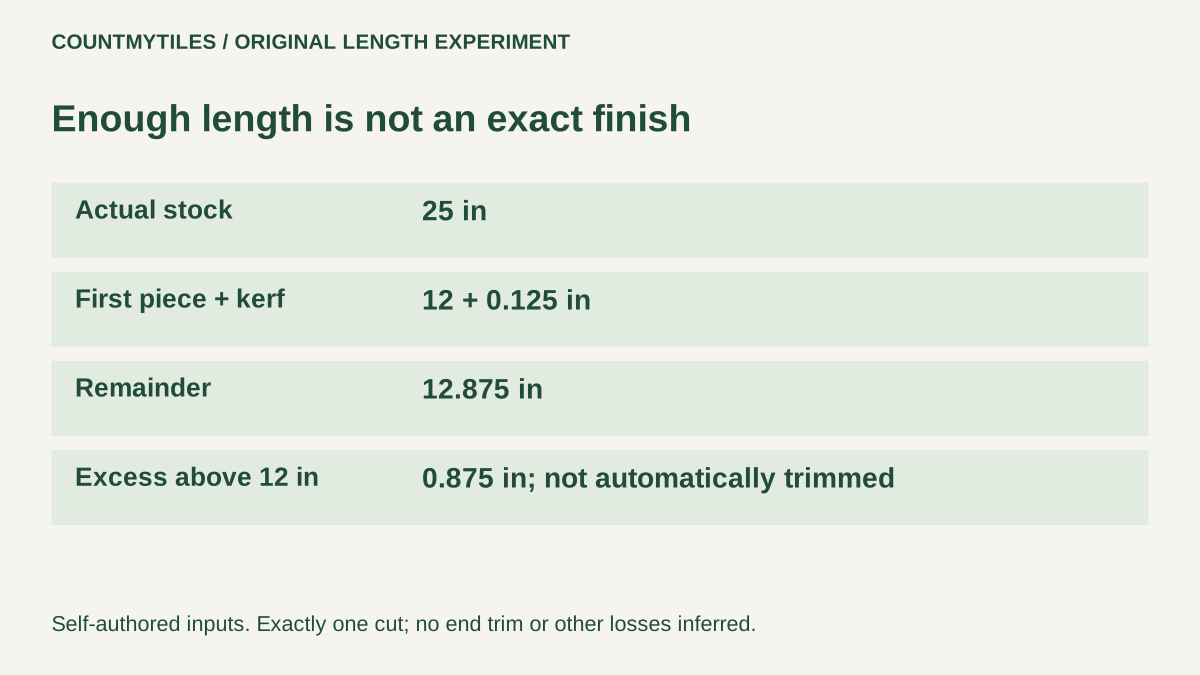
Try a longer remainder as a boundary check. With stock 25, first piece 12 and kerf 0.125, the remainder is 12.875 inches. That is at least twelve, but it is not an exact twelve-inch finished piece. Our worksheet reports 0.875 inch of excess and does not silently trim it away. Finishing the second piece would introduce another cut or a separate finishing operation, whose losses are outside this single-cut record.
Use the worksheet to reproduce these controls, changing one field at a time. Editing a field clears the previous result and disables copying until recalculation. An unchecked single-cut confirmation, a blank length or a first piece plus kerf longer than the stock produces an error. A zero-length remainder is allowed when the first piece and kerf consume all the stock; it cannot meet a positive second-piece requirement.
Keep the input record with the result. Our arithmetic accepts explicit decimal inches with at most four decimal places and performs subtraction with scaled integers. This avoids turning an exact entered equality into a tiny floating-point shortfall. It does not make a tape measure accurate to four decimal places, establish usable edges or confirm the cut that a physical tool will make.
What belongs in this tile estimator?
Enter the actual stock length, the required finished first-piece length, the consumed width of the single cut and the second required length, all in decimal inches. The model assumes a constant-width rectangular tile or strip and one transverse cut. It does not include end squaring, chips, polishing, blade deflection or other finishing losses. Confirm that this limited geometry matches your intended calculation.
Do not substitute a product's nominal label for an actual length. A blade diameter is also not its cut width. The QEP 7-1008BW manufacturer page lists a separate Kerf Width field of 1.2 mm in Dimensions. We checked that field through the page reader on October 21, 2026; direct HTML access returned HTTP 429. That product field supports the distinction between dimensions, not our hypothetical 0.125-inch input or a universal measured loss.
Questions answered
Can one 24-inch tile make two exact 12-inch pieces?
Not in our one-cut model with any positive consumed width: the two twelve-inch pieces already use the entire 24 inches. With our authored 0.125-inch loss, the second piece is 11.875 inches. This question is self-authored by CountMyTiles, not a quotation from a customer.
Does a sufficient remainder prove the second piece is ready?
No. A longer remainder passes a length-only availability check but is not automatically trimmed to the required finished dimension. Width, edge condition, direction, pattern and any extra cut must be checked separately. This worksheet neither joins fragments nor solves a two-dimensional cutting layout.
Method and limits
The length identity is remainder = stock − first piece − one kerf. Minimum stock = first piece + one kerf + second required length. The identity is basic arithmetic; our authored cases, controls, ledger, diagrams and interactive comparison are the worked material on this page. Exactly one cut is counted. Do not extend this result to an arbitrary number of pieces by assuming that only one fewer cut than pieces is always needed: a final remainder may need additional trimming.
The same cut-model.js serves this worksheet and the public calculation interface. Lengths are bounded to one million inches; required lengths are positive and kerf may be zero as an idealized control. For overall quantity estimates use the tile calculator. For counting already owned usable whole tiles see our existing stock audit. Neither article certifies that a particular offcut meets a required finished size.