Our 100-square-foot rate-basis experiment
We wrote both sets of terms for this experiment. They are not a contractor's quotation, a survey of local prices or a recommendation for what to charge. Choose 100 square feet of installed area, a 60-square-foot first tier, USD 8 per square foot in that tier, and USD 6 for the remaining area. The lower rate is an authored scenario input. Our question is whether changing the basis alone changes the answer while those four numbers stay fixed.
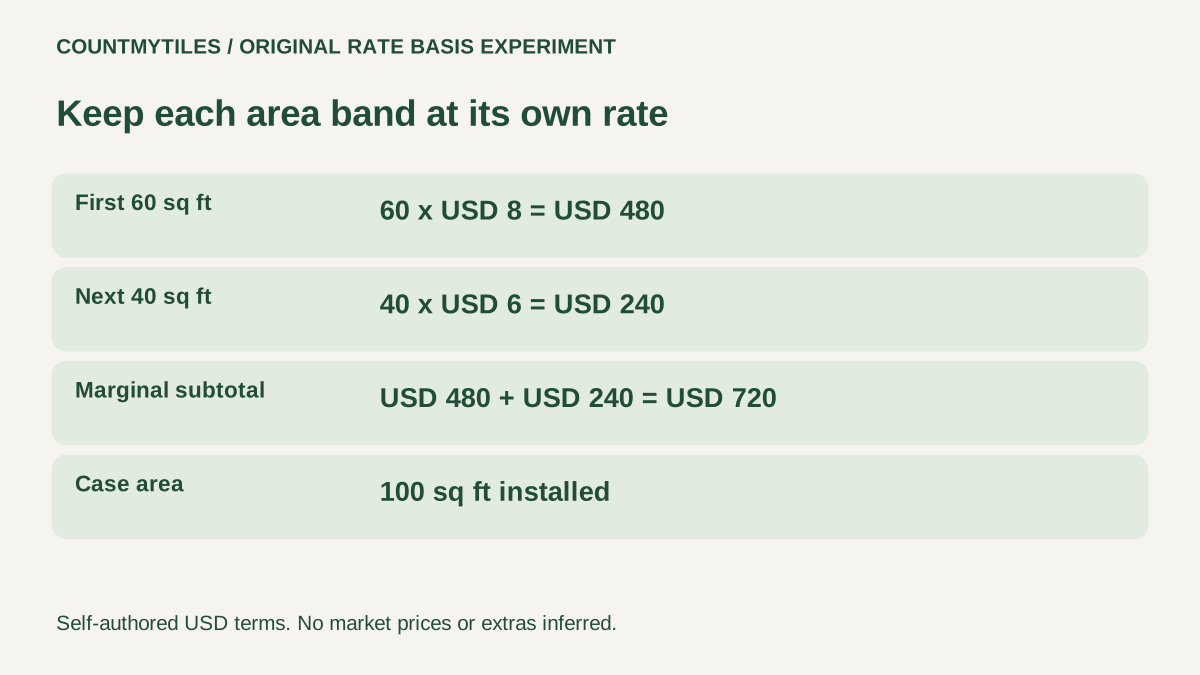
For the marginal interpretation, the first tier receives the smaller of the installed area and sixty. That is sixty square feet here. The excess receives the larger of area minus sixty and zero, giving forty. Multiply each area by its own rate: 60 × 8 = 480 dollars and 40 × 6 = 240 dollars. Add the two amounts to get 720 dollars. The effective subtotal per installed square foot is 720 ÷ 100 = 7.20 dollars, between the two entered rates.
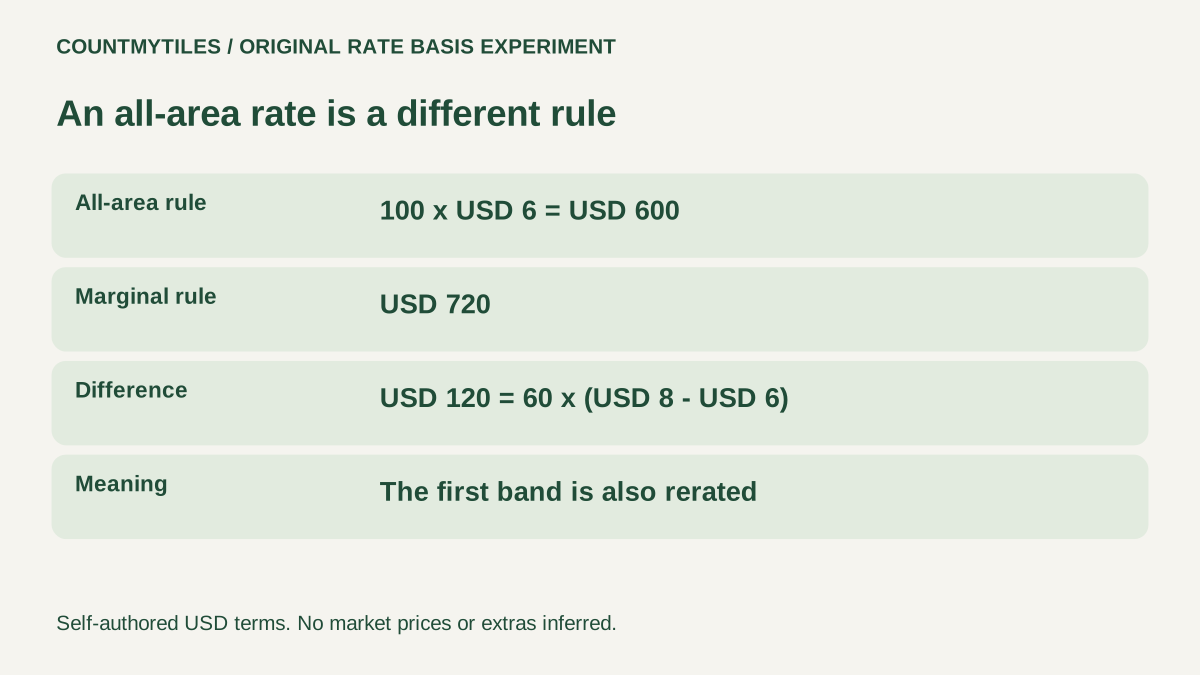
For the second interpretation, we explicitly write a different rule: use eight dollars on all the area when the area is at most sixty; use six dollars on all the area when it exceeds sixty. At one hundred square feet this produces 100 × 6 = 600 dollars. It removes 120 dollars from the marginal result because the first sixty square feet also receive a two-dollar reduction. The difference is 60 × (8 − 6), not a missing forty-square-foot charge.
That comparison does not establish which amount belongs on anyone's invoice. The all-area rule needs explicit wording just as the marginal rule does. A phrase such as “six dollars above sixty square feet” does not tell this worksheet which basis a real quotation intended. Record the exact terms and ask the quote's issuer whether the lower rate applies only to the additional area or to every square foot. A spreadsheet formula cannot resolve missing wording.
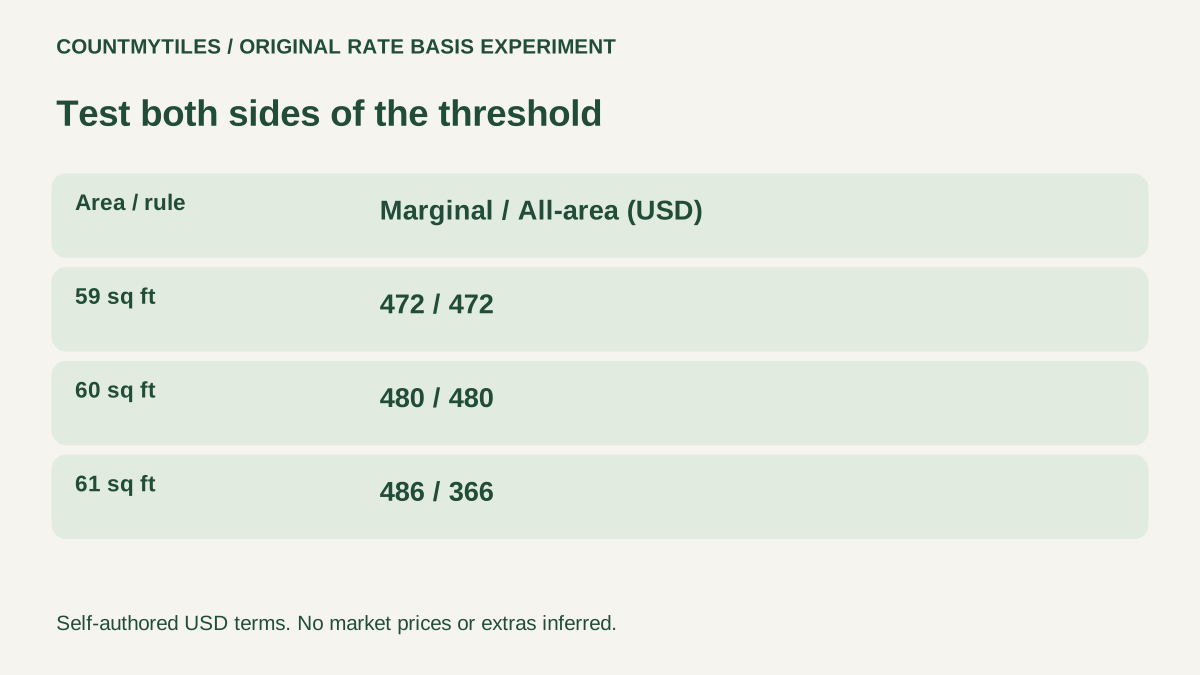
Now test the boundary without changing either rate. At fifty-nine square feet, both authored rules give 59 × 8 = 472 dollars. At exactly sixty, both give 480 dollars. At sixty-one, marginal tiers give 480 + 1 × 6 = 486 dollars. Our all-area rule gives 61 × 6 = 366 dollars. Its total drops when the threshold is crossed. That drop follows the specific authored rule; it is not a claim about standard trade practice. The marginal result rises by six dollars for the additional square foot.
One more control helps isolate the cause. Set both rates to eight while leaving the area and threshold unchanged. Both bases then give eight hundred dollars at one hundred square feet. With equal rates, reassigning the first band has no effect. Set the next rate to zero and the marginal subtotal stops increasing after sixty, while the all-area subtotal becomes zero above sixty. Zero is accepted only as an explicit input, never supplied as a missing value.
Reload the example, change the installed area and watch the old result clear. Calculate again before copying. The copied record includes all four inputs and both conditional subtotals, so a later reader can reproduce the comparison. A negative area, a zero threshold or a blank rate must be corrected before a result appears. These controls protect the meaning of the experiment; they do not certify the scope of a real agreement.
Use installed area and keep the quote scope separate
The area is the surface that the quote bills for installation. Do not automatically add tile ordering waste to it. This worksheet models two rates and one threshold only. A total minimum, demolition, preparation, taxes and other items require their own explicit terms. Use our minimum-charge worksheet for a total labor floor and our quote scope audit to track separate included and excluded items. Do not add those outputs together without checking for overlapping charges.
Questions answered
Does the lower rate always apply to the whole job?
No. That depends on the actual quote wording. This comparison shows what each explicitly defined rule produces; it does not choose the applicable rule.
What happens at exactly the threshold?
Our authored all-area rule keeps the first rate at equality. The marginal calculation has no excess area at that point. A different quoted boundary must be modeled separately.
Are these current labor prices?
No. All example terms are self-authored. Enter your own explicit rates; no location or market price is inferred.
Method record
CountMyTiles authored the questions, figures and boundary experiments on October 16, 2026. Marginal subtotal = min(area, threshold) × first rate + max(area − threshold, 0) × next rate. All-area subtotal = area × first rate at or below the threshold; otherwise area × next rate. This is a two-rule arithmetic experiment, not a quotation source.
Inputs accept at most two decimal places. The shared model uses integer hundredths for square feet and integer cents for rates, sums the products, then rounds each subtotal once to cents, half up. An invoice that rounds each line separately can differ. Currency is USD, and rates and areas are bounded to one million. No minimum, discount, extras or material parameters are invented.
The fixed comparison pages reviewed for this series explain tile quantity and general cost inputs. This page supplies our own two-basis experiment and threshold controls. That observation concerns the saved reviewed pages; it does not claim that every page on those sites lacks tiered pricing. The source of every rate on this page is the labeled authored case or an explicit worksheet input.