Our 60-square-foot shape audit
We authored a centered trapezoid with a twelve-foot bottom base, an eight-foot top base and six feet of perpendicular separation. These are chosen geometry inputs, not measurements from a customer's room. The top base sits two feet inward from each bottom corner. We chose this arrangement so its area can be checked in two independent ways, while the sloping edges remain visibly longer than the height.
The direct calculation averages the parallel edges: (12 + 8) ÷ 2 = 10 feet. Multiply by the six-foot height to obtain sixty square feet. Ten feet is a computed mean base, not another measured edge. Retain the original three inputs in your notes so another person can distinguish the two actual edges from the calculated mean.
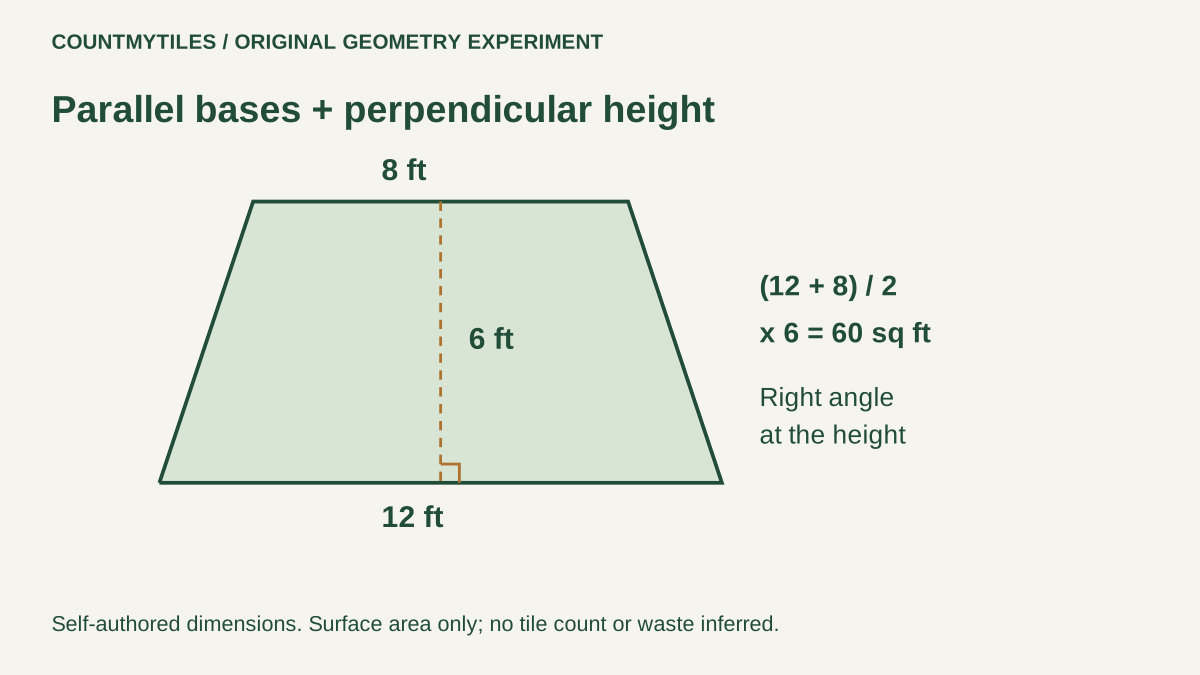
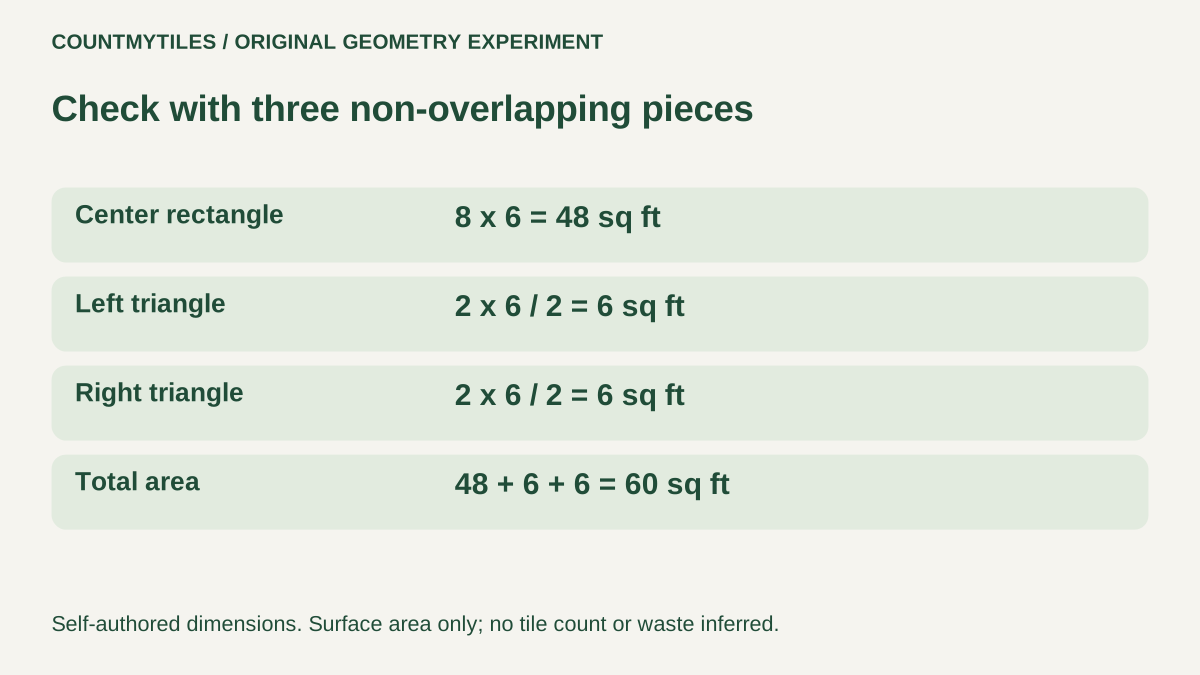
For an independent check, drop a perpendicular from each end of the eight-foot top base. The middle becomes an eight-by-six rectangle, worth forty-eight square feet. Each outer piece is a right triangle with a two-foot horizontal base and the same six-foot perpendicular height. Each triangle contributes 2 × 6 ÷ 2 = 6 square feet. Add forty-eight, six and six to recover sixty. These pieces share boundaries without overlapping area.
The enclosing twelve-by-six rectangle would contain seventy-two square feet. The two missing upper corner triangles together contain twelve, so subtracting them also gives sixty. Using the longer base alone would overstate this particular shape by twelve square feet. Using only the shorter base would understate it by twelve. Neither rectangle is a substitute for the actual trapezoid.
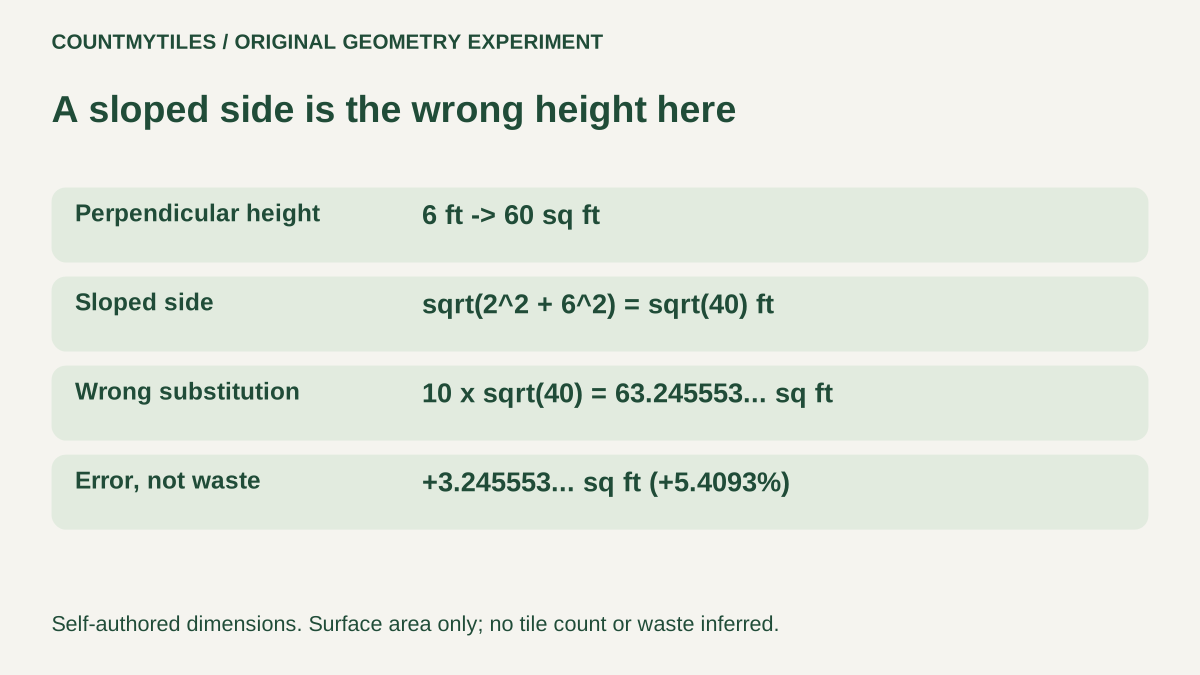
Now deliberately substitute the sloped side for the height. Its horizontal change is two feet and its vertical change is six, so its length is √(2² + 6²) = √40, approximately 6.324555 feet. Multiplying the ten-foot mean base by that sloped length gives approximately 63.245553 square feet. That is about 3.245553 square feet, or 5.4093 percent, above sixty. The extra amount is entirely an input-definition error in our experiment. It is not an allowance for cuts, breakage or ordering waste.
Notice that rounding the sloping measurement to 6.32 does not fix the error: 10 × 6.32 still gives 63.2 square feet. The problem is which segment was measured. A more precise number for the wrong segment cannot replace perpendicular separation. The worksheet can check numeric values and require your confirmation, but it cannot inspect the room or verify that your tape line was perpendicular.
Use two controls before trusting your own record. Swapping the twelve-foot and eight-foot base labels must leave the answer at sixty. Setting both parallel bases to twelve with height six must give seventy-two, the rectangle area control. Sliding the upper base sideways while preserving both base lengths and their perpendicular separation also preserves the area, although it changes the side lengths. That is why this worksheet does not need a sloping side measurement or assume that a real surface is centered.
Load our example, change one value, and the old result clears until you calculate again. Copy the new result with all three input dimensions and the geometry confirmation. If a base is blank, a height is zero or the confirmation is unchecked, correct the record before using an output. The copied decimal result retains floating-point arithmetic; the screen rounds to six decimals for readability and does not promise six-decimal measurement accuracy.
Which measurements belong in the worksheet?
Use two straight parallel boundary edges and their perpendicular separation, all in decimal feet on the same flat surface. Label the edges A and B on a sketch and mark the right angle at the height line. A sloping wall boundary is a side length. It is the height only if it actually meets the parallel bases at right angles. Four side lengths alone do not establish the required height for this worksheet.
If the edges are not parallel, the outline curves, or the surface contains several shapes, this single-trapezoid formula is insufficient. Decompose the outline into supported shapes with no overlapping area or obtain the missing geometry. Our overlap audit treats two axis-aligned rectangles; it does not turn arbitrary quadrilaterals into trapezoids.
Questions answered
Can I enter the sloping edge as the height?
Only when that edge is perpendicular to the parallel bases. Our authored sloping edge is not, so entering it produces the wrong area shown above. This question and every example on this page were written by CountMyTiles, not quoted from a customer.
Does sixty square feet mean sixty tiles?
No. Surface area alone does not specify tile size, joints, edge cuts, layout, offcut reuse or box size. You can carry the area into the main tile calculator using its total-area mode and your explicit tile and ordering inputs. That mode does not reconstruct this trapezoid's cut layout.
Method and source record
The geometric definition and formula are supported by OpenStax, Prealgebra 2e, section 9.4, Properties of Trapezoids, Figures 9.25–9.27: area = (base A + base B) × perpendicular height ÷ 2. We checked this source on October 20, 2026. The formula is established geometry; the sixty-square-foot comparison, decomposition, deliberate error and controls are our own worked material.
The browser worksheet and public calculation interface share trapezoid-model.js. Inputs must be finite positive numbers at most one million feet, with explicit parallel and perpendicular confirmation. Calculations use JavaScript floating-point numbers. No tile waste, product coverage, construction tolerance or price is inferred. Equal bases are accepted as the rectangle/parallelogram control; the source's strict trapezoid definition distinguishes that case.