Our 80-square-foot endpoint experiment
We authored this case to separate three records: the nominal dimensions, the allowed dimension ranges entered for this experiment, and the digits shown on screen. Nothing here was measured at a customer's home. We choose 120 inches by 96 inches and a bound of one eighth of an inch for each side. That bound is a scenario input, not a manufacturer's accuracy specification, a recommended tolerance or a statistical claim.
The nominal area is 120 × 96 ÷ 144 = 80 square feet. Subtract 0.125 from each dimension to obtain the lower pair: 119.875 and 95.875 inches. Add 0.125 to each dimension to obtain the upper pair: 120.125 and 96.125 inches. All four endpoints are positive. Because a rectangle's area increases as either positive dimension increases, multiplying the two lower endpoints gives the minimum over these entered ranges. Multiplying the upper endpoints gives the maximum.
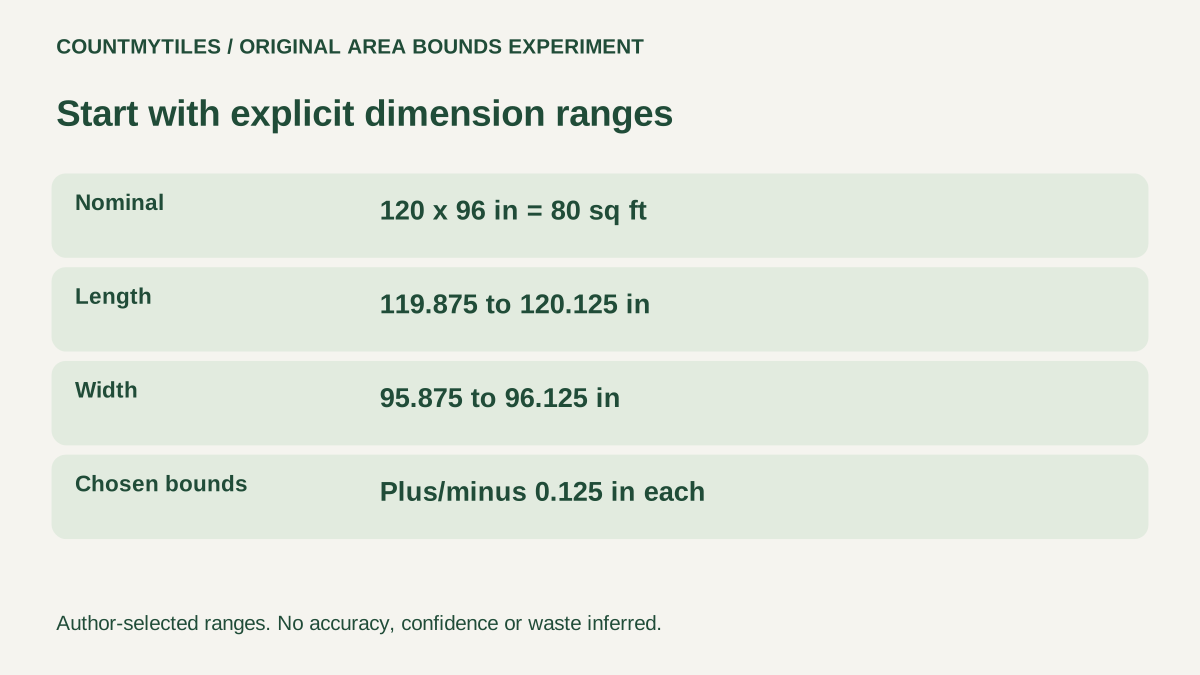
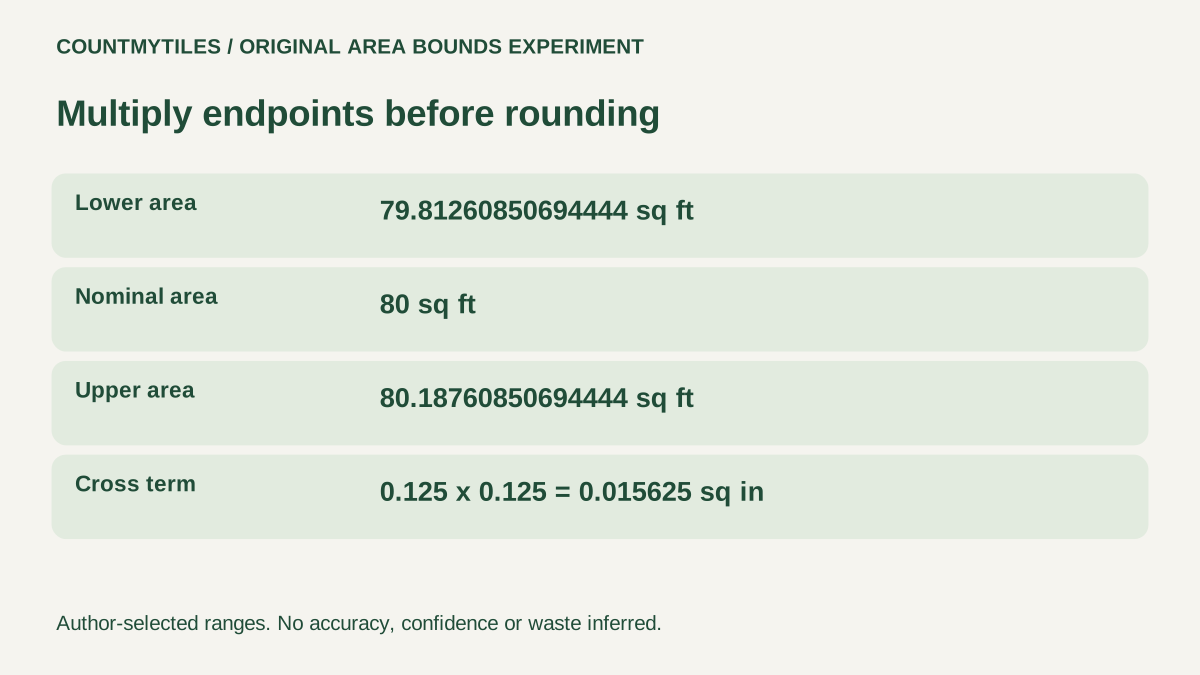
Our lower product is 11,493.015625 square inches, or 79.81260850694444 square feet. The upper product is 11,547.015625 square inches, or 80.18760850694444 square feet. The nominal rectangle sits between them. Notice that its distance to the upper endpoint is about 0.187608507 square feet, while its distance to the lower endpoint is about 0.187391493. The area range is slightly asymmetric around eighty even though both entered dimension ranges are symmetric.
The small asymmetry has a visible arithmetic cause. Expanding the upper product gives LW + Wa + Lb + ab, where a and b are the two entered bounds. The lower product is LW − Wa − Lb + ab. Here the two linear terms sum to 27 square inches, while their cross term is 0.015625 square inches. Keeping that cross term in both endpoint products avoids replacing the experiment with a symmetric approximation. It contributes 0.00010850694444 square feet to each product relative to that approximation.
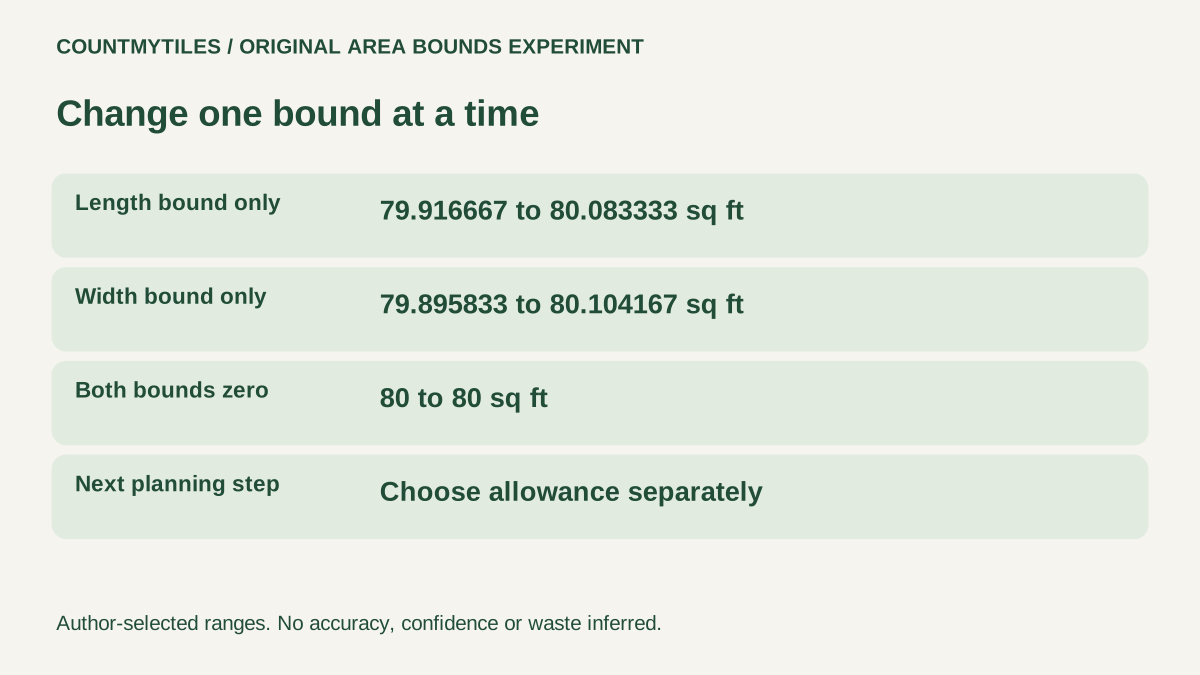
Next, hold the width fixed by entering zero for its bound, while retaining 0.125 for the length bound. The area becomes approximately 79.916667 to 80.083333 square feet. Reverse the experiment: length bound zero, width bound 0.125. Now the area is approximately 79.895833 to 80.104167 square feet. The same one-eighth-inch change has a larger area effect on width because it is multiplied by the longer, 120-inch side. These are two separate sensitivity experiments, not evidence that one physical measurement is better.
Finally, set both bounds to zero. The lower, nominal and upper areas all become eighty. This says only that the entered scenario contains no range. It does not certify perfect measurement. Reload the example, change a dimension, and observe that the previous result clears until you calculate again. Enter a bound equal to its nominal dimension to check the rejection of a zero lower endpoint. Copying a successful result retains the four inputs and computed endpoints for a later audit.
Use the area record before choosing a purchase allowance
This worksheet returns rectangular area only. It does not infer how many tiles a layout needs or turn the area spread into a waste percentage. Bring the nominal area and the entered range to your planning record, then use the main tile calculator with a separately chosen allowance. If the outline is not a rectangle, these endpoint products do not describe that outline. See our overlap audit when the issue is shared floor between rectangles.
Questions answered
Does 80.000000 sq ft mean my measurement is exact?
No. Those are display digits. They do not establish the range of the original dimensions or the accuracy of a device.
Is this a 95% confidence interval?
No probability model or confidence level is supplied. The result covers combinations inside the entered dimension ranges under this rectangular model. Whether real dimensions fall inside them is a separate question.
Should I use the upper endpoint as the tile order?
An area endpoint is not an order. Layout, cuts, a separately chosen allowance and package size still matter. This page does not select them for you.
Method record and sources
CountMyTiles authored the questions, diagrams and experiments on October 15, 2026. The worksheet accepts symmetric, independently entered ranges for positive rectangular dimensions; it evaluates their full Cartesian combination, even if a real measurement process could constrain that combination. JavaScript floating-point arithmetic is used. No physical precision is inferred from the returned digits.
NIST defines the inch as exactly 25.4 mm and the international foot as exactly 0.3048 m (section B.6). Their ratio gives twelve inches per foot and 144 square inches per square foot. These definitions support the conversion only; our chosen bounds and endpoint experiment are our own.
The fixed comparison pages reviewed for this series explain area and tile quantity inputs. This page adds our specific two-bound experiment, cross-term audit and one-bound-at-a-time comparisons. That claim is limited to the reviewed pages, not every page on those sites. For a transcription error rather than an entered range, use our feet-and-inches audit.